It seems with every year, you get better and better. Well, one would hope, I guess. I have had the unique opportunity to 'learn all over again' by teaching 6th grade this year. I often am reminded that these kiddos are learning things for the first time and I get to be the one to introduce concepts and skills. As fun as is it, it is also an incredible amount of pressure. I want to be sure I am providing accurate and sound information and on top of that, I want it to make sense to them.
As we talk about formulas, it is important to me that they know WHY the formulas are what they are; I don't just want them to accept them without knowing why. I must have said, "I could have just given you these formulas and said, 'have at it,' but I want you to understand WHY!"
I have never presented the surface area and volume of rectangular prisms in this way, but I think it really paid off.
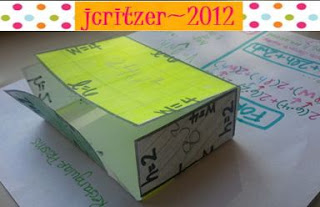
Here is how we started. I gave them a blank net and asked them what they noticed. Most quickly discovered that there were pairs of rectangles that were the 'same.' We solidified our understanding by clarifying that the areas of the rectangles were the same. I asked them to color code the rectangles so that the same colors had the same area. From there we labeled the rectangles with the exact areas.
I asked the students how they determined the areas of each of these rectangles, which lead us into the conversation regarding the dimensions. Because this is a 2D picture of a 3D object, at first we only labeled all lengths and widths. Before we could completely defend our areas measuring 8 square units, we cut out the net and folded it to create the rectangular prism. We did not tape or glue it together as we would eventually glue it down to our note sheet and didn't want to ruin it trying to un-tape it.
It was at this point, we could start talking about the previously missing dimension~height. The students were now able to defend their areas of 8 square units because they saw that the height of the 'box' was 2 units.
So, this is the part that I did differently from years past. If you look closely, you can see that I started off the derivation of the formula with the numbers from the example, then I showed which dimension each represented, and from there we derived the formula. Now, I'm sure it didn't take the rest of you 10 years of teaching to figure out that was the way to go, but it did me...I need help...but we've already established that :-)
The kiddos picked up the fact that the volume of a rectangular prism was the area of the top (length times width) multiplied by the number of layers (the height). I can't say they discovered this from the net, but rather a 'do now' activity that my amazing PLC partner created.
The kids simply flattened out the net when it was time for them to place in their binders. It was important to me that they had the capability of folding it flat to see the net as well as the capability of folding it up to see the rectangular prism.