Showing posts with label unique. Show all posts

Monday, April 30, 2012

Mean, Median, Mode, and Range

I can't even begin to describe the work we put our brains through last week when we approached 'mean as a balance point' vs 'mean as fair share.'  Luckily, my kids are amazing and we challenged ourselves and ultimately came out on top, if I must say so myself.

Although most of my kiddos remembered median, mode, and range, I wanted to make sure they had notes in case they forget.  Also, it was important to me to make sure that they had notes comparing and contrasting mean as described above--as a balance point and as fair share.

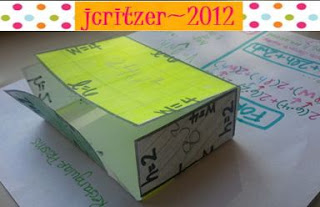
I thought a semi-cootie catcher would do the trick with a little extra love on the 'mean' flap.  :-)


I was very mindful in how each word was written except for 'mean', which I knew would need two separate images for balance point and fair share, so I left the outside word 'normal-looking.'  You can see a green line (barely) under the word 'mode.'  The kids picked up on the idea that the mode is the response or data point that occurs the most often, sort of the way the word 'mode' appears here, as if it were on a line plot (come on, work with me here!).  Range has the arrows to demonstrate that it shows how spread out a data set is.  The picture didn't copy all that well for median, but I watermarked a median in the middle of two neighborhood streets and spread the word 'median' out (in the middle of the word, of course) to make that reference.

You can (kind of) see from the picture above that the mean flap has a flap within the flap.  Here is what is going on there...


Here, I was trying to show mean as a balance point within the phrase with the use of a balance scale.  Notice it is balanced :-)

And the other side to this flap within a flap...


Here I was trying to show that with mean as fair share, you are finding the average by divvying up the data points into even groups, hence, the 4 squares with one letter per box.

When you open the flap within a flap all the way open, this is what we created...


We based our outside flaps on the steps we completed throughout the week as we found mean as a balance point and mean as fair share and we used the example in the middle to show how mean as a balance point can be used to find an estimate when the data cannot be 'perfectly balanced' and then you can find mean as fair share to determine a more specific mean.

For consistency, on the inside flaps of mode, median, and range, we used the same data.


I knew this foldable was going to be pretty cumbersome with all of the gluing and the mind-boggling revisiting of mean as a balance point vs mean as fair share, so I kept the kids writing to a limit in the general descriptions for mean, median, mode, and range.  We just did a little underlining and highlighting.

Friday, April 13, 2012

Pythagoras, O Pythagoras!

I think I mentioned earlier that one of the concepts I miss teaching now that I've switched from 8th grade to 6th grade is The Pythagorean Theorem.

I decided to covered this with the students headed to Algebra next year prior to teaching surface area and volume of cones and rectangular pyramids so that I can incorporate some multi-step problems where they have to find the slant height or the height prior to finding the other measurements.

Here is what I gave each kiddo:


They need both because one is taped down to the composition book and the other is cut and used to prove the theorem.

In order to prove the theorem, we labeled the dimensions of the triangle and the squares and color coded each square.


From there, we cut out one of the pictures along the perimeter and we cut the other picture so that the largest square was still attached to the triangle, but the other two squares were separated. Then, we glued the squares with the triangle intact into our math 'textbook' attaching the triangle only to the paper. From there I showed the kids how one of the remaining smaller squares fit into the larger square and by trial and problem solving, we discovered how the remaining square could be cut to cover the remaining area of the largest square, thus proving the Pythagorean Theorem. I was sure to explain that this is ONE of many proofs, but I really like how the notes became the proof in this case!


Wednesday, April 11, 2012

i have been put to shame!

here i am thinking i am helping the better good and creating foldables and then my PLC partner BLOWS ME OUT OF THE WATER! She created an AMAZING foldable to show the relationships between and among parallelograms.

the best part:

i kept getting to say 'cootie catcher' when i was giving instructions because you fold part of the foldable in like a cootie catcher (fortune teller for those of you still scratching your head trying to figure out what on earth i'm talking about)

need to get her permission to post a picture...ashamed i'm not create enough to come up with anything this cool, but what can i say, she's a genius!

one of my students today said, "you guys should sell all of these foldables you create." how sweet was that : )

Monday, March 26, 2012

Area of a Trapezoid

First and foremost, let me apologize for the extremely poor quality of these photos.
Covered this with my students moving up to Algebra next year. We don't cover the area of a trapezoid in 6th grade.
As usual, I wanted them to understand the 'why' behind the formula.
We simply took a sheet of paper and hamburger folded it, ripped it, and shared with our neighbor (each student only needs 1/2 a sheet of paper). from there we folded it in half again, hamburger style. Then, we cut some off of the left and right sides to create a trapezoid from the rectangle.
To show that the formula of a trapezoid is 1/2 the height multiplied by the two base lengths added together, we folded the top layer of the trapezoid so that the front showed 1/2 the height. We glued it such that the portion of the trapezoid we cut off matched up with the 'flap' created from the fold.
{unfolded}
{folded up}

Cylinders

Along the same lines as surface area and volume of rectangular prisms, I went with the net approach for the surface area and volume of cylinders. I think it really allowed the students to see the connection between the circumference and the length of the rectangle as well as the connection between the height and the width being the same distance.
{what you cannot see here is the 2nd circle, which has been taped down to the note page. Before we developed the formula, we talked about the cylinder being made of two circles and a rectangle. To develop the surface area formula we talked about need the area formula for a circle twice as there are two circles and then the area of the rectangle, which could be obtained from the circumference multiplied by the height}
Similar to the discovery of the volume of a rectangular prism being the area of the top multiplied by the number of 'layers,' the students discovered that the volume of a cylinder is simply the area of the circle multiplied by the number of 'layers.'

Rectangular Prisms

It seems with every year, you get better and better. Well, one would hope, I guess. I have had the unique opportunity to 'learn all over again' by teaching 6th grade this year. I often am reminded that these kiddos are learning things for the first time and I get to be the one to introduce concepts and skills. As fun as is it, it is also an incredible amount of pressure. I want to be sure I am providing accurate and sound information and on top of that, I want it to make sense to them.
As we talk about formulas, it is important to me that they know WHY the formulas are what they are; I don't just want them to accept them without knowing why. I must have said, "I could have just given you these formulas and said, 'have at it,' but I want you to understand WHY!"
I have never presented the surface area and volume of rectangular prisms in this way, but I think it really paid off.
Here is how we started. I gave them a blank net and asked them what they noticed. Most quickly discovered that there were pairs of rectangles that were the 'same.' We solidified our understanding by clarifying that the areas of the rectangles were the same. I asked them to color code the rectangles so that the same colors had the same area. From there we labeled the rectangles with the exact areas.
I asked the students how they determined the areas of each of these rectangles, which lead us into the conversation regarding the dimensions. Because this is a 2D picture of a 3D object, at first we only labeled all lengths and widths. Before we could completely defend our areas measuring 8 square units, we cut out the net and folded it to create the rectangular prism. We did not tape or glue it together as we would eventually glue it down to our note sheet and didn't want to ruin it trying to un-tape it.
It was at this point, we could start talking about the previously missing dimension~height. The students were now able to defend their areas of 8 square units because they saw that the height of the 'box' was 2 units.
So, this is the part that I did differently from years past. If you look closely, you can see that I started off the derivation of the formula with the numbers from the example, then I showed which dimension each represented, and from there we derived the formula. Now, I'm sure it didn't take the rest of you 10 years of teaching to figure out that was the way to go, but it did me...I need help...but we've already established that :-)
The kiddos picked up the fact that the volume of a rectangular prism was the area of the top (length times width) multiplied by the number of layers (the height). I can't say they discovered this from the net, but rather a 'do now' activity that my amazing PLC partner created.
The kids simply flattened out the net when it was time for them to place in their binders. It was important to me that they had the capability of folding it flat to see the net as well as the capability of folding it up to see the rectangular prism.